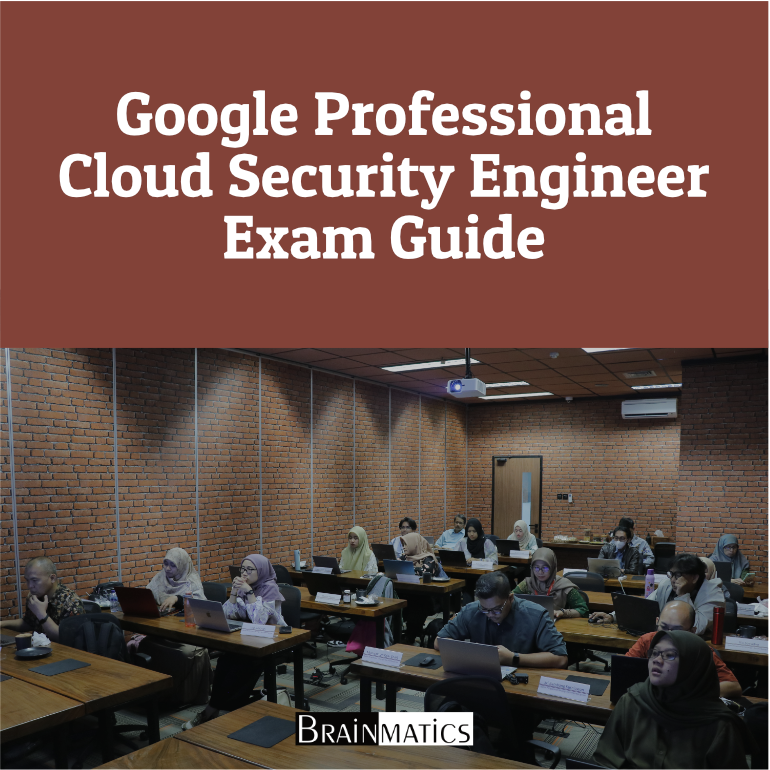
 Keamanan di lingkungan cloud menjadi aspek krusial bagi perusahaan yang mengadopsi teknologi Google Cloud Platform (GCP). Banyak organisasi menghadapi tantangan dalam mengelola identitas dan akses, melindungi data sensitif, mengamankan jaringan cloud, serta mendeteksi dan merespons ancaman keamanan. Tanpa pemahaman yang baik mengenai praktik keamanan cloud, perusahaan dapat menghadapi risiko seperti kebocoran data, serangan siber, serta kegagalan dalam memenuhi kepatuhan terhadap regulasi industri.
Course Google Professional Cloud Security Engineer Exam Guide ini dirancang untuk membekali peserta dengan keterampilan dan wawasan mendalam mengenai strategi keamanan dalam Google Cloud, serta membantu mereka mempersiapkan diri untuk ujian sertifikasi Google Professional Cloud Security Engineer. Peserta akan mempelajari cara mengelola identitas dan akses menggunakan IAM, mengamankan sumber daya cloud, serta memahami keamanan jaringan, enkripsi data, dan pemantauan keamanan. Selain itu, peserta juga akan mendapatkan pemahaman tentang praktik terbaik dalam menerapkan kebijakan keamanan, logging, dan respons insiden di lingkungan GCP.
Dengan kombinasi materi berbasis praktik dan studi kasus, course ini akan memberikan pemahaman menyeluruh tentang bagaimana menerapkan keamanan cloud yang kuat, meningkatkan kesadaran terhadap risiko, serta membangun infrastruktur cloud yang aman dan sesuai dengan standar industri.
OBJECTIVES
1. Memahami konsep keamanan cloud dan bagaimana menerapkannya di Google Cloud Platform (GCP)
2. Meningkatkan keterampilan dalam manajemen identitas dan akses (IAM) untuk memastikan hanya pengguna yang berwenang yang dapat mengakses sumber daya cloud
3. Memahami strategi pemantauan, logging, dan respons insiden untuk mendeteksi dan mengatasi ancaman keamanan secara proaktif
4. Mampu mengamankan komputasi, penyimpanan, dan jaringan dengan menerapkan kontrol keamanan dan kebijakan enkripsi
AUDIENCE
1. Cloud Security Engineer
2. Cybersecurity Analyst
3. Google Cloud Administrator
4. DevOps Engineer
5. IT Security Specialist
CONTENT
1. Google Cloud Security Concepts
1.1 Overview of Google Cloud Security
1.2 Shared Security Responsibility
1.3 Security by Design
1.4 Threat and Vulnerability Management
2. Trust and Compliance
2.1 Establishing and Maintaining Trust
2.2 Access Transparency and Access Approval
2.3 Security and Privacy of Data
2.4 Third-Party Risk Assessments
3. Resource Management
3.1 Overview of Google Cloud Resource Manager
3.2 Understanding Resource Hierarchy
3.3 Applying Constraints Using the Organization Policy Service
3.4 Asset Management Using Cloud Asset Inventory
3.5 Best Practices and Design Considerations
4. Understanding Google Cloud Security
4.1 Overview of Cloud Security
4.2 Securing Account
4.3 Directory Management
5. Google Cloud Identity and Access Management
5.1 Overview of IAM
5.2 Service Accounts
5.3 IAM Policy Bindings
5.4 Tag-Based Access Control
5.5 Cloud Storage ACLs
5.6 IAM APIs
5.7 IAM Logging
6. Virtual Private Cloud
6.1 Overview of VPC
6.2 Google Cloud Regions and Zones
6.3 VPC Deployment Models
6.4 Micro-Segmentation
6.5 Cloud DNS
6.6 Load Balancers
6.7 Hybrid Connectivity Options
6.8 Best Practices and Design Considerations
7. Advanced Network Security
7.1 Private Google Access
7.2 Identity-Aware Proxy
7.3 Cloud NAT
7.4 Google Cloud Armor
8. Google Cloud Key Management Service
8.1 Overview of Cloud KMS
8.2 Encryption and Key Management in Cloud KMS
8.3 Key Management Options
8.4 Symmetric Key Encryption
8.5 Asymmetric Key Encryption
8.6 Import a Key (BYOK)
8.7 Key Lifecycle Management
8.8. Key IAM Permissions
8.9 Cloud HSM
8.10 Cloud EKM
8.11 Cloud KMS Best Practices
8.11 Cloud KMS API
8.12 Cloud KMS Logging
9. Cloud Data Loss Prevention
9.1 Overview of Cloud DLP
9.2 DLP Architecture Options
9.3 Cloud DLP Terminology
9.4 Creating a Cloud DLP Inspection Template
9.5 Best Practices for Inspecting Sensitive Data
9.6 Inspecting and De-Identifying PII Data
9.7 How to De-Identify and Tokenize Sensitive Data
9.8 DLP use Case
9.9 Best Practices for Cloud DLP
9.10 Data Exfiltration and VPC Service Controls
9.11 Best Practices for VPC Service Controls
10. Secret Manager
10.1 Overview of Secret Manager
10.2 Managing Secrets and Versions
10.3 Accessing a Secret
10.4 Secret Replication Policy
10.5 CMEKs for Secret Manager
10.6 Best Practices for Secret Management
10.7 Secret Manager Logs
11. Cloud Logging
11.1 Introduction to Google Cloud Logging
11.2 Log Categories
11.3 Log Management
11.4 Logging and Auditing Best Practices
12. Image Hardening and CI/CD Security
12.1 Overview of Image Management
12.2 Image Management Pipeline
12.3 Controlling Access to the Images
12.4 Image Lifecycle
12.5 Enforcing Lifecyle Policies
12.6 Securing a Ci/CD Pipeline
12.7 Best Practices for CI/CD Security
12.8 Shielded VMs
12.9 Confidential Computing
13. Security Command Center
13.1 Overview of SCC
13.2 Core Services
13.3 Cloud Asset Inventory
13.4 Detecting Security Misconfigurations and Vulnerabilities
13.5 Threat Detection
13.6 Continuous Compliance Monitoring
13.7 Automating a Findings Response
14. Container Security
14.1 Overview of Containers
14.2 Container Basics
14.3 What is Kubernetes
14.4 Container Security
14.5 GKE Security Features
14.6 Container Security Best Practices
Course Features
- Lectures 70
- Quizzes 2
- Duration 40 hours
- Skill level All levels
- Language Indonesia
- Students 0
- Certificate No
- Assessments Yes
- 20 Sections
- 70 Lessons
- 40 Hours
- PERSIAPAN2
- 1. OVERVIEW OF GOOGLE CLOUD PLATFORM2
- 2. GOOGLE CLOUD COMPUTING SERVICES4
- 3. PROJECTS, SERVICE ACCOUNTS, AND BILLING6
- 4. INTRODUCTION TO COMPUTING IN GOOGLE CLOUD4
- 5. COMPUTING WITH COMPUTE ENGINE VIRTUAL MACHINES4
- 6. MANAGING VIRTUAL MACHINES3
- 7. COMPUTING WITH KUBERNETES4
- 8. MANAGING KUBERNETES CLUSTERS5
- 9. COMPUTING WITH APP ENGINE4
- 10. COMPUTING WITH CLOUD FUNCTIONS3
- 11. PLANNING STORAGE IN THE CLOUD3
- 12. DEPLOYING STORAGE IN GOOGLE CLOUD PLATFORM8
- 13.112.1 Deploying and Managing Cloud SQL
- 13.212.2 Deploying and Managing Datastore
- 13.312.3 Deploying and Managing BigQuery
- 13.412.4 Deploying and Managing Cloud Spanner
- 13.512.5 Deploying and Managing Cloud Pub/Sub
- 13.612.6 Deploying and Managing Cloud Bigtable
- 13.712.7 Deploying and Managing Cloud Dataproc
- 13.812.8 Managing Cloud Storage
- 13. LOADING DATA INTO STORAGE3
- 14. NETWORKING IN THE CLOUD: VIRTUAL PRIVATE CLOUDS AND VIRTUAL PRIVATE NETWORKS4
- 15. NETWORKING IN THE CLOUD: DNS, LOAD BALANCING, AND IP ADDRESSING3
- 16. DEPLOYING APPLICATIONS WITH CLOUD LAUNCHER AND DEPLOYMENT MANAGER2
- 17. CONFIGURING ACCESS AND SECURITY2
- 18. MONITORING, LOGGING, AND COST ESTIMATING4
- PENUTUPAN2